
One Day, Two Elections: Why Northern Ireland’s 2027 Council Elections Matter
By David McCann, Strategic Political Analyst at Brown O’Connor | Ireland
When we think about next year's elections, local council elections often take a back seat to the Assembly Election. Not since 2011 have voters in Northern Ireland had both elections on the same day.
That’s right, we are not just electing 90 MLAs but also 462 councillors. This election will decide both the make-up of our Executive and all 11 of our councils.
Why do these local elections matter?
Councils in Northern Ireland are much less powerful than their counterparts across the water. However, even with less power, they still control millions of pounds in spending and have powers over a range of important issues such as planning, local services and promoting the local economy. Their ability to raise the profile of issues and campaigns is also worth noting.
Another important fact about our councils is they are the most stable form of local governance that we have. While the Assembly has collapsed on numerous occasions and we have been left for years (nearly 40% of the time since 1999) without a devolved government, local councils have continued operating. They take decisions, deliver services, and remain accountable to their local communities.
If you want to engage the most stable and consistent part of our government, local councils are a great place to start and plan with certainty.
Why do parties care about local elections?
Political parties care about local council results, and for good reason. An effective local councillor can identify local issues that an MLA or group of Ministers need to know about. Councillors are often the first port of call for members of the public or community organisations to highlight problems in the constituency. A cohort of active local councillors not only boosts the party's profile but also lets the wider parliamentary party keep its finger on the pulse.
Our councils, like the Assembly, operate on the d’Hondt system for allocating the number of positions each party is entitled to in a council. That means the more seats a party has on a council, the more prominent spots, such as Mayor, it is entitled to during that mandate. Electing more councillors helps a party secure a higher profile and gives it more voting power in the council chamber to influence policy decisions.
Many future MLAs and MPs will start their careers in local councils. Of the main party leaders, Michelle O’Neill, Naomi Long, Gavin Robinson and Claire Hanna all started their careers in local government before moving on to higher office.
Does party support vary?
With the elections on the same day as the Assembly, what should we watch for? The first thing is turnout. When local government elections are held separately, turnout is typically about 10% lower than in Assembly elections. With both elections on the same day, turnout in the local election should rise, but it remains unclear whether the higher turnout we have seen in Assembly elections since 2017 will hold up.
On the parties themselves, when you look back to 2011, what jumps out is how support for the parties varies even when the election is held on the same day:
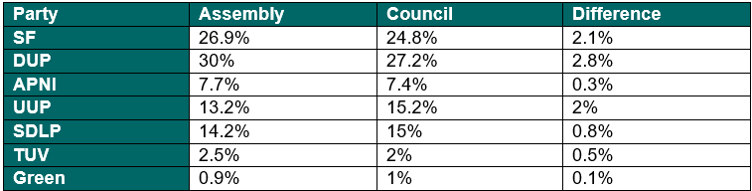
What is striking when you compare vote share from 2011 is the difference between Sinn Féin, DUP and UUP vote shares. At Assembly level, likely because of the race for First Minister and the strength within the Executive, the big two parties drew a pool of voters who moved away from them when it came to voting for their local councillors. The SDLP also performed a bit better in the council elections than in the Assembly.
As the SDLP and UUP look to these elections for signs of recovery, it will be worth paying as much attention to the local council results as to the Assembly. Sinn Féin and the DUP have a lot of ground to defend as they come into this race as the largest parties. Likewise, Alliance is defending a raft of gains since 2019.
Whatever the results are, these elections will matter and warrant as much attention as the Assembly contest. For both wider politics and policy impact, the parties that make inroads in our councils will have something important to celebrate.